
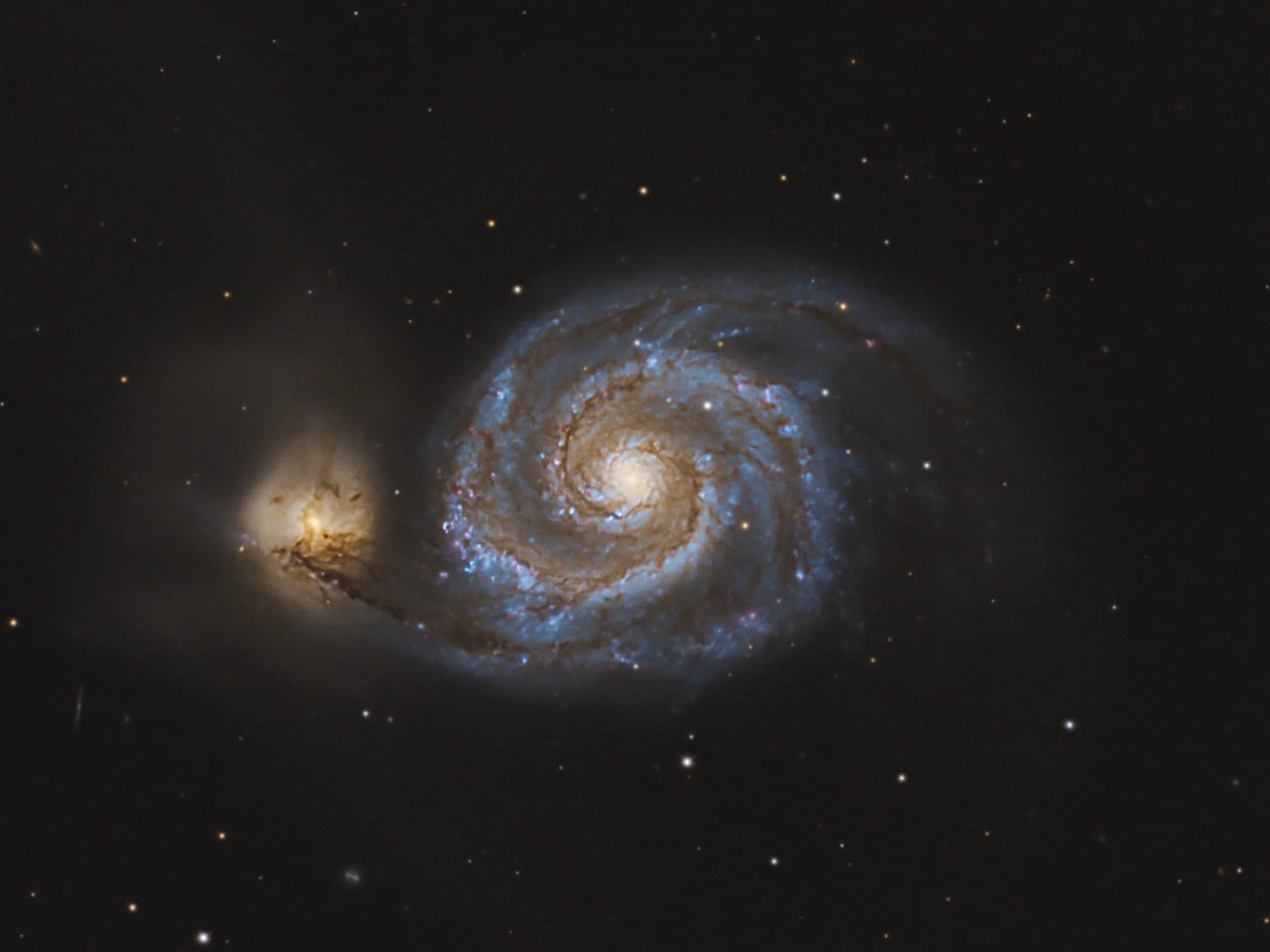
What changed when I moved from a 300 mm RedCat 61 to an EdgeHD 8 at about 1,422 mm? M51 gained room in the frame, making dust lanes and bright knots easier to separate. Tracking, focus, seeing, and the data still set the limit.
This was first light with my Celestron EdgeHD 800. An existing wide-field M51 image provides a direct comparison. The two images answer different questions: the RedCat shows the whole shape efficiently, while the longer focal length gives the galaxy more room to show its internal structure. You can open the full EdgeHD M51 gallery image and compare the finished frame with the earlier field note here.
The two views of M51
My earlier image used a William Optics RedCat 61 at roughly 300 mm. At that scale, M51 is clearly recognizable, but it occupies a small part of the frame. The two galaxies and the overall spiral pattern are present; the finer divisions within the arms are much harder to read.
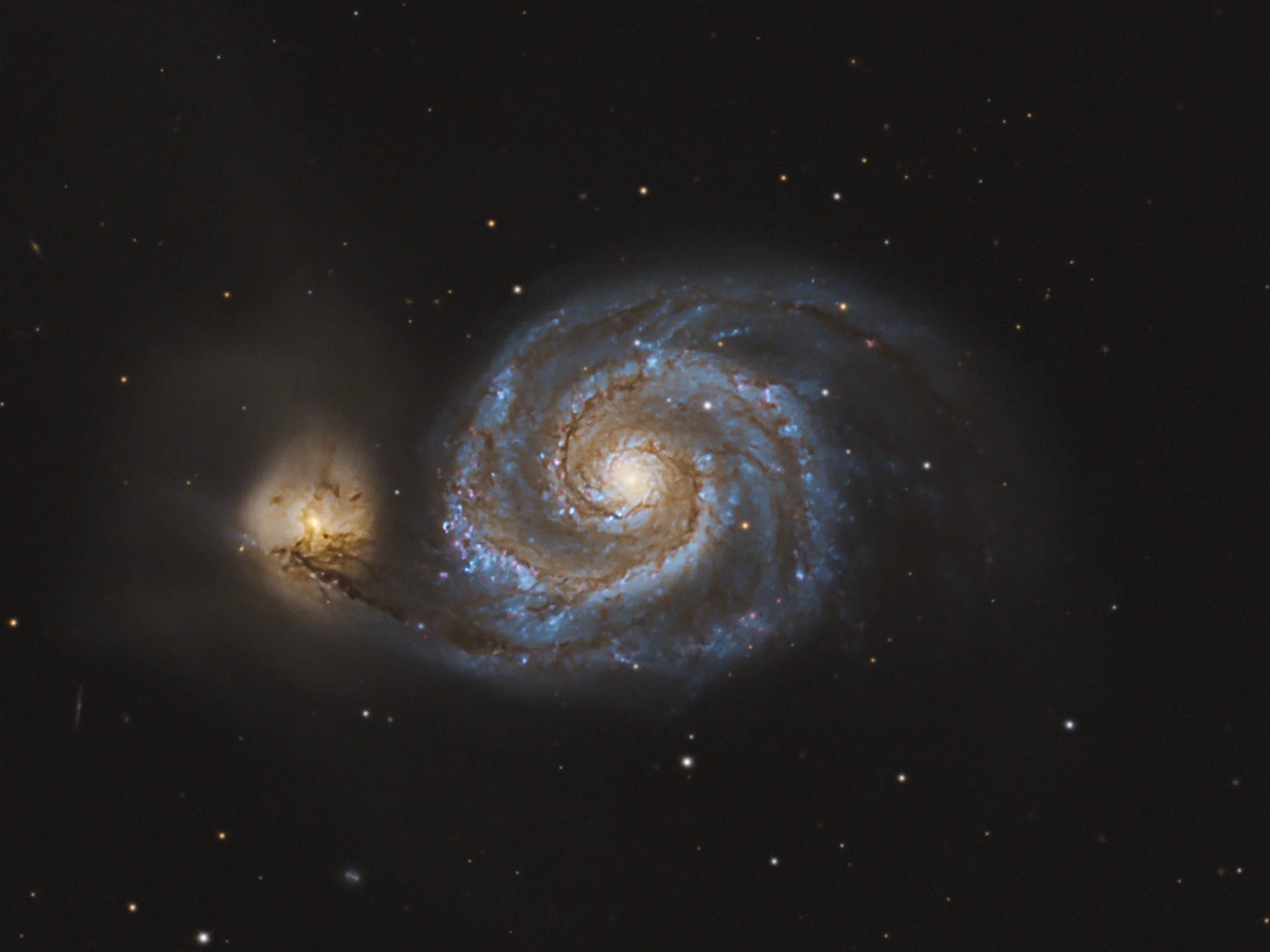
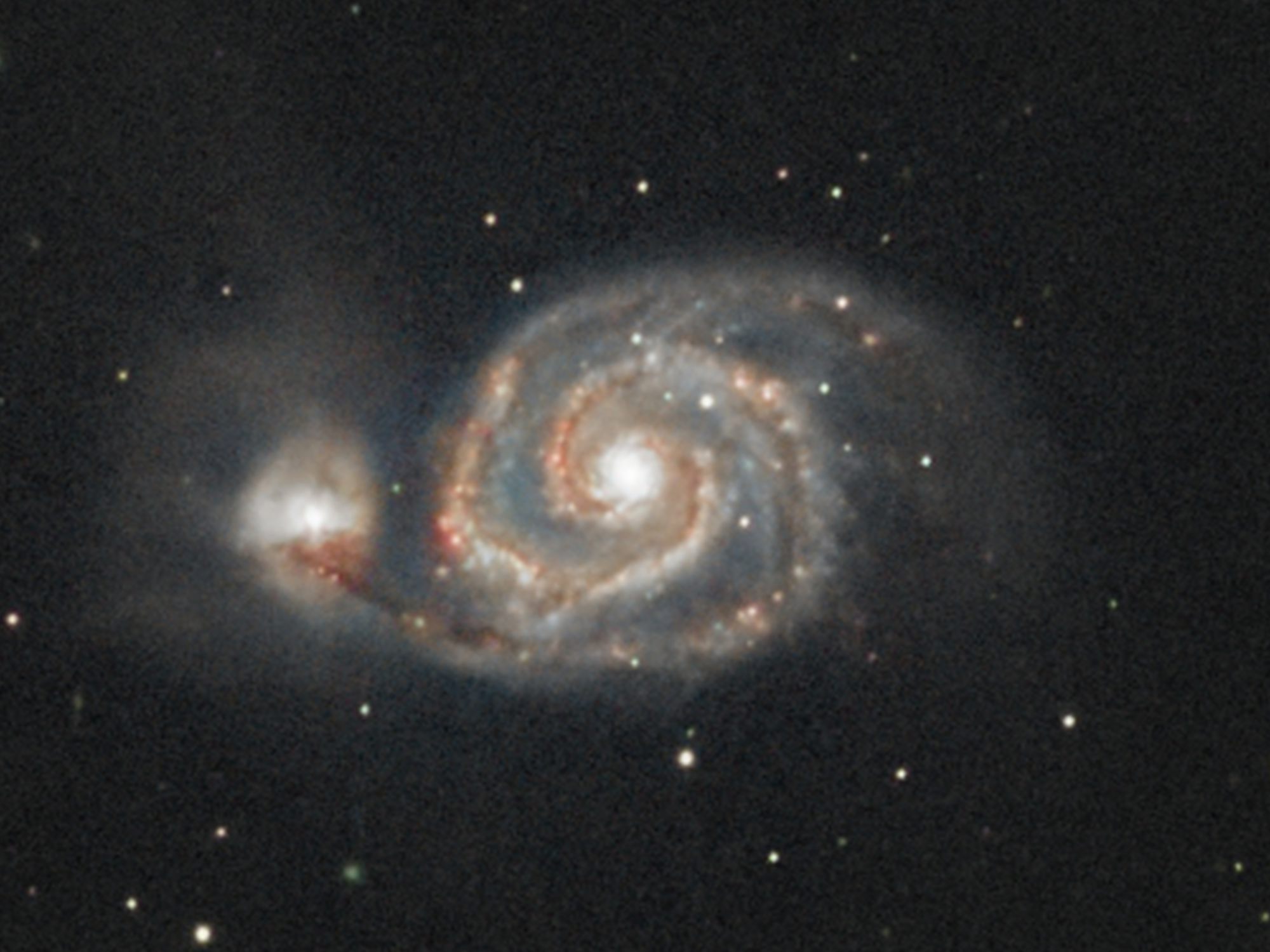 RedCat 61EdgeHD 8
With the EdgeHD 8 and its 0.7x reducer, the focal length is about 1,422 mm. In my new image, M51 fills much more of the frame. Dust lanes cross the spiral structure, bright star-forming regions appear as separate knots, and the bridge toward NGC 5195 is easier to follow.
I am careful with the word "resolved" here. A longer focal length spreads a target across more pixels, while aperture, focus, tracking, atmospheric seeing, camera sampling, and total exposure determine how much of that information survives. The EdgeHD did not create detail that was absent from the photons. It made the detail in this data easier to distinguish.
What the optical change contributed
The EdgeHD 8 is an 8-inch Schmidt-Cassegrain built for a very different working range from the RedCat. Celestron lists a native focal length of 2,032 mm for the EdgeHD 8 and about 1,422 mm with the matched 0.7x reducer. The reducer gives me a more practical field while keeping the setup much longer than the 300 mm refractor.
The RedCat remains the better fit when I want a wide region of sky, a forgiving composition, or a target that benefits from generous surroundings. Its shorter focal length makes small tracking errors less visible in the frame, while the way focus errors appear depends on the full optical train, sampling, and seeing. The EdgeHD narrows the view and increases the demands on the whole imaging train. That trade is worthwhile when the target is small enough that a wide-field frame leaves its internal structure under-sampled.
The comparison chart makes that framing change visible before I ask the image to carry the explanation.
The capture had to earn the detail
The new gallery record contains 203 five-minute exposures for a confirmed 16h55m integration. I used the Celestron EdgeHD 8 with the 0.7x reducer, a ZWO ASI2600MC Pro camera, and a ZWO AM5 mount from my Florida Bortle 6 sky. The data was processed in PixInsight with no filter.
Those facts describe the setup, but they do not promise a particular result. At 1,422 mm, a small tracking error moves a star farther across the sensor during the same exposure than it would at 300 mm. The full optical train and sampling determine how a focus shift appears, while atmospheric turbulence can soften the fine structure even when the mount is behaving. The session therefore required attention to tracking, focus, and seeing.
That is why I would not describe this as a simple upgrade from "less zoom" to "more zoom." The EdgeHD gives me a narrower field and more potential image scale, but it also asks for steadier data and more careful decisions. The original RedCat image is valuable precisely because it records what the target looked like under a more forgiving setup.
Why M51 looks like a whirlpool
M51 lies in Canes Venatici, near the handle of the Big Dipper, and is paired on the sky with the smaller galaxy NGC 5195. NASA/JPL describes the system as approximately 23 million light-years away and notes the mutual gravitational distortion between the two galaxies. Other professional references use different approximate distances, so I am keeping that value qualified rather than presenting it as a measurement made by this photograph.
The companion's pull helps explain why M51 has such a strong two-arm pattern. Gas and stars respond to the interaction, and the arms become regions where material is compressed and new stars can form. In the image, the blue-white knots and reddish patches are visual clues to different stellar and gaseous environments, shaped by the camera, exposure, sky, and processing. The colors are not a complete chemical inventory.
What the image can and cannot show
My frames directly show the apparent shapes, relative brightness, star field, dust lanes, and the companion's position on the sky. The comparison also shows how the same target changes when the image scale and framing change.
The photograph cannot measure the exact distance to M51, prove the speed or history of its interaction, or identify the age and composition of an individual knot by color alone. Those conclusions come from professional measurements, including spectroscopy and observations at other wavelengths. The image gives me a visual record of the structure those observations help explain.
That boundary keeps the first-light lesson useful. More focal length can make a target easier to study, but a photograph is still evidence gathered under particular conditions. It is not a substitute for every measurement behind the story.
A first light that changed what I can ask
The EdgeHD 8 opened a new set of targets for me: smaller galaxies, tighter compositions, and revisits to objects I had previously photographed only as small shapes. M51 was the clearest first comparison because the RedCat frame was already part of my history.
The new image feels like a continuation rather than a replacement. The RedCat showed me the Whirlpool Galaxy as a pair and a pattern. The EdgeHD let me spend more time with the dust lanes, knots, and companion. The telescope changed the question from "Can I record M51?" to "Which structures can this data support?"
For the next step, the M51 gallery record keeps the acquisition facts and full image together. My processing guide explains the calibration, stacking, stretching, and finishing decisions that turn exposures like these into a readable frame. The galaxy portrait notes return to M51 among other distant targets and show why image scale is only one part of a useful galaxy photograph.